Choosing reliable Titanium Automotive Exhaust Manifold Studs suppliers requires more than comparing prices or polished product photographs. The right supplier understands heat cycling, galvanic corrosion, thread accuracy, and installation stress. These studs may sit beside glowing exhaust runners, where temperatures rise and fall repeatedly. A weak material decision can become a seized nut, damaged thread, or difficult repair.
Metallurgist Dr. John Campbell has emphasized a valuable manufacturing principle: “Quality depends on process control, not material reputation.” That principle applies directly here. Grade 5 titanium may offer excellent strength-to-weight performance, but alloy selection alone does not prove product quality. Buyers should examine mill certificates, tensile data, thread standards, dimensional tolerances, and batch traceability. Surface treatment also deserves attention. Titanium’s behavior against stainless steel nuts, aluminum heads, and high-temperature coatings can vary significantly.
Look beyond the catalogue.
Experienced suppliers should explain torque guidance, anti-seize compatibility, and thermal expansion. They should also identify whether their studs are machined, rolled, or cold-formed. Each process can influence thread durability and fatigue resistance. A supplier who avoids technical questions may not understand demanding exhaust environments.
Still, no supplier is perfect. Published data may contain gaps, and laboratory figures may not reflect every vehicle platform. That uncertainty deserves honest review. This guide compares leading Titanium Automotive Exhaust Manifold Studs suppliers through engineering evidence, production consistency, customer support, and real-world suitability. The goal is practical selection, not exaggerated marketing.
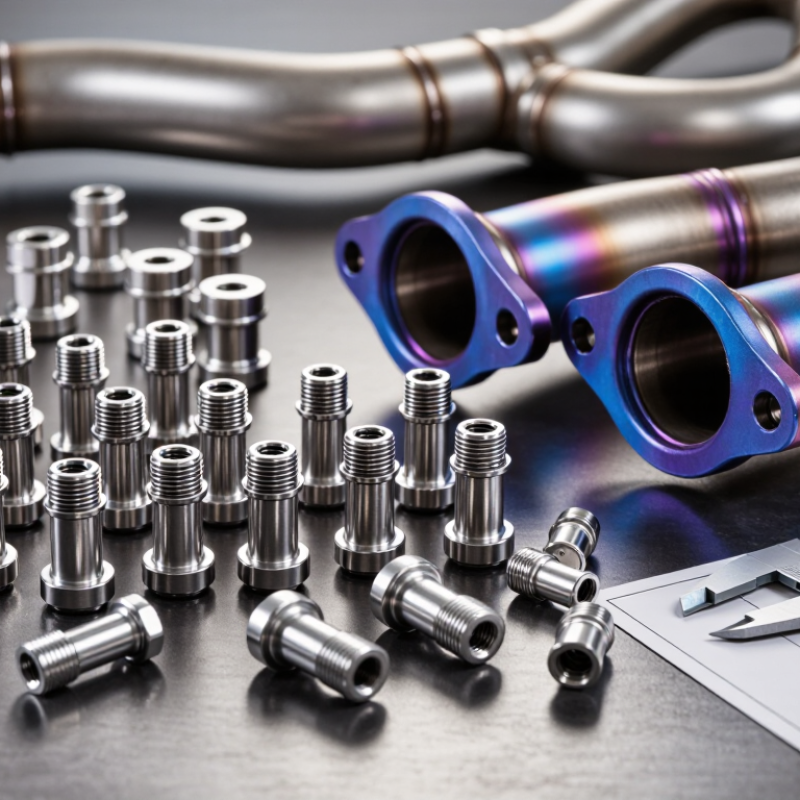
Titanium automotive exhaust manifold studs are threaded fasteners that secure the exhaust manifold to the cylinder head. They must withstand vibration, repeated heat cycles, and clamp loads. Unlike conventional steel studs, titanium provides lower weight and strong corrosion resistance. That weight saving can help performance-focused vehicles. It also resists moisture and salt exposure well. However, titanium is not automatically the best choice. At sustained exhaust temperatures, some titanium alloys lose strength faster than heat-resistant steel. Grade selection therefore matters.
In practical installation, clean both threaded surfaces carefully. Titanium threads can gall, especially when installed dry or over-tightened. Use a compatible, high-temperature anti-seize compound. Do not guess torque values. Follow tested specifications for the stud, nut, and cylinder-head material. Thermal expansion differences can also change clamp load during heating.
I have seen lightweight hardware fail because temperature limits were ignored. That experience changed how I assess suppliers. Reliable suppliers should provide material certificates, dimensional reports, heat-treatment details, and traceable batch records. Tensile data and service-temperature guidance are equally important. A polished finish alone proves little.
The better question is whether the stud remains stable after repeated heating, cooling, and vibration.
Titanium manifold studs reduce mass while resisting corrosion and repeated thermal cycling. ASM Handbook, Volume 2, lists titanium alloy density near 4.43 g/cm³, compared with about 7.85 g/cm³ for carbon steel. That difference can remove roughly 40% of stud weight. Small savings matter around a compact exhaust flange.
Grade 5 titanium is commonly selected for its strength-to-weight ratio. ASTM B348/B348M data specify minimum tensile strength near 895 MPa for this alloy. It also avoids the rust staining seen on untreated steel hardware. Suppliers should provide heat-lot traceability, chemical analysis, tensile results, and thread inspection records. Good documentation matters more than a polished finish.
The material still has limits. Titanium can gall during installation, especially with dry threads and high torque. Use compatible anti-seize and follow the supplier’s torque guidance. Do not copy steel torque values. Exhaust surfaces may exceed 700°C under severe operation, and titanium’s high-temperature strength declines as temperature rises. I would not call every titanium stud a racing upgrade. Some designs prioritize low mass, while others need maximum clamp stability. The International Titanium Association also notes titanium’s strong corrosion resistance, but that does not remove installation risks. A careful supplier should state the alloy grade, thread class, temperature guidance, and recommended nut material clearly. Missing data is a warning sign.
When evaluating titanium exhaust stud suppliers, begin with material evidence, not polished sales claims. Ask for the exact titanium grade, heat-treatment details, and a current mill certificate. Grade 5 titanium may suit many performance applications, but temperature limits still matter. A supplier should explain them clearly.
Inspect the supplier’s manufacturing controls. Thread accuracy affects installation, sealing, and future service. Request dimensional reports for thread diameter, pitch, shoulder length, and surface finish. Small burrs can damage an aluminum cylinder head. Titanium also tends to gall, so ask how threads are finished and which installation compound they recommend. Keep it practical. Can they provide sample studs for torque testing? Can they trace each batch to inspection records?
Experience should appear in useful details. A capable supplier will discuss exhaust heat cycles, vibration, nut compatibility, and clamping force without making unrealistic promises. They should also explain packaging, because scratched threads can ruin an otherwise precise part. Check production capacity, lead times, nonconformance procedures, and communication during design changes. Certifications help, but certificates alone do not prove reliable workmanship. I have seen impressive documentation hide weak quality control. That possibility deserves attention. Compare measured samples, not just PDFs. A thoughtful supplier may even question titanium selection for an unusually hot application and suggest a more suitable material. That honesty is valuable.
| Evaluation Dimension | Recommended Technical Benchmark | Documents or Tests to Request | Why It Matters for Exhaust Manifold Studs |
|---|---|---|---|
| Titanium Material Grade | Common options include Commercially Pure Titanium Grade 2 for corrosion resistance and Ti-6Al-4V Grade 5 for higher strength-to-weight performance. The selected grade should match the design temperature, preload, and corrosion environment. | Material certificate showing chemistry, heat or lot number, product form, and applicable ASTM or equivalent specification. | Titanium grades have different strength, ductility, machinability, and temperature-performance characteristics. |
| Chemical Composition | Chemistry should conform to the ordered titanium grade, including controlled levels of aluminum, vanadium, oxygen, nitrogen, hydrogen, iron, and carbon where applicable. | Heat-analysis report or third-party positive material identification report linked to the supplied lot. | Small chemistry variations can affect strength, ductility, fatigue behavior, and resistance to hydrogen-related damage. |
| Tensile and Yield Strength | For Ti-6Al-4V fastener material at room temperature, typical minimum requirements depend on the product specification and condition; Grade 5 bar and fastener requirements commonly specify tensile strength near 895 MPa or higher and yield strength near 825 MPa or higher. | Lot-specific tensile test report with test direction, specimen condition, elongation, reduction of area, and test standard. | Strength determines the stud’s ability to maintain clamping force without yielding during assembly and thermal cycling. |
| Operating Temperature Capability | Exhaust manifold temperatures can vary substantially by engine and operating condition. The supplier should provide temperature-dependent mechanical data rather than relying only on room-temperature ratings. | Application-specific temperature assessment, elevated-temperature tensile data, and recommended installation limits. | Room-temperature strength alone cannot predict preload retention at elevated exhaust temperatures. |
| Thread Standard and Fit | The stud must match the specified thread form, diameter, pitch, tolerance class, thread length, and unthreaded shank dimensions. Metric and Unified threads should not be mixed. | Approved drawing, thread plug or ring gauge results, pitch-diameter measurements, and first-article inspection report. | Correct thread geometry prevents installation damage, poor engagement, loosening, and uneven manifold clamping. |
| Thread Surface Finish | Threads should be free from tearing, laps, burrs, and galling damage. Surface finish and coating or lubricant requirements should be defined in the purchase specification. | Visual inspection criteria, dimensional inspection records, surface-finish measurements where specified, and sample installation results. | Titanium has a strong tendency to gall during installation, especially when titanium threads contact titanium threads. |
| Anti-Galling Control | The supplier should provide a compatible installation lubricant, surface treatment, or dissimilar-material pairing and state the resulting torque-tension conditions. | Torque-tension test report, lubricant technical data sheet, installation procedure, and recommended tightening speed. | Galling can seize the stud and nut, damage threads, and produce unreliable preload before the specified torque is reached. |
| Torque-Preload Relationship | Tightening torque should be established for the exact thread size, lubricant, nut material, washer condition, and target preload. A generic torque chart is not sufficient for critical assemblies. | Torque-preload test data from multiple samples, including friction assumptions and test setup details. | Torque is an indirect method of controlling preload and can vary significantly with friction and surface treatment. |
| Fatigue and Thermal Cycling | For severe-duty applications, evaluate cyclic loading, repeated heat exposure, vibration, and preload loss using an application-representative test profile. | Fatigue data, thermal-cycle test plan, vibration results, and post-test dimensional or crack inspection. | Exhaust studs experience vibration and repeated heating and cooling, which can contribute to fatigue or joint relaxation. |
| Corrosion and Oxidation Resistance | Titanium generally provides strong resistance to many automotive corrosive environments, but performance depends on grade, temperature, deposits, mating metals, and chemical exposure. | Material-grade certificate, environmental exposure data where relevant, and galvanic-corrosion assessment for the mating nut and manifold. | Corrosion can reduce thread integrity and make future manifold removal difficult. |
| Dimensional Quality Control | Critical dimensions should be inspected against the approved drawing, including major diameter, pitch diameter, thread length, total length, concentricity, chamfer, and end condition. | Certificate of conformance, inspection plan, capability data for critical dimensions, and sample inspection report. | Consistent dimensions support correct fit, repeatable assembly, and stable load distribution across the manifold flange. |
| Traceability | Each shipment should be traceable to the raw-material heat, production lot, inspection records, and any applied coating or lubricant batch. | Lot code, material heat number, certificate of conformance, inspection records, and packaging identification. | Traceability enables containment, root-cause analysis, and controlled replacement if a quality issue occurs. |
| Manufacturing Process | The supplier should clearly identify whether the studs are cold formed, hot formed, machined, rolled-threaded, or cut-threaded, and explain how the process suits the selected titanium grade. | Process flow chart, process control plan, thread-process description, and inspection records for the supplied lot. | Manufacturing route influences grain flow, thread strength, surface damage, dimensional consistency, and production cost. |
| Quality Management | Prefer a documented quality system with controlled drawings, nonconformance handling, calibration, change control, and corrective-action procedures. | Current quality-system certificate, audit summary, calibration records, and sample corrective-action report with sensitive information removed. | A controlled quality system reduces variation between production lots and supports reliable automotive supply. |
| Sample Approval and Validation | Approve production-intent samples before volume purchasing. Samples should use the same material, process, thread specification, surface treatment, and packaging as regular production. | First-article inspection report, dimensional samples, installation trial, torque-preload validation, and approved sample record. | Sample approval confirms that the supplier can meet the actual design and assembly requirements, not just a general catalog specification. |
| Supply and Packaging Reliability | Confirm minimum order quantity, standard lead time, capacity, safety stock options, packaging protection, and change-notification procedures. | Capacity statement, delivery performance records, packaging specification, and written engineering-change notification policy. | Consistent delivery and protected threads are essential for production continuity and trouble-free assembly. |
Top Titanium Automotive Exhaust Manifold Studs Suppliers?
Selecting titanium exhaust manifold studs requires more than comparing prices. A reliable supplier should provide material certificates, batch traceability, dimensional inspection, and documented thermal-cycle testing. ASTM B348 Grade 5 titanium offers a minimum tensile strength of 895 MPa and a density near 4.43 g/cm³. However, strength changes under sustained exhaust heat. This makes application testing essential, not optional.
Look for suppliers operating under ISO 9001 or IATF 16949 systems. Ask about thread accuracy, surface treatment, galling resistance, and installation torque data. SAE technical literature highlights thermal cycling and joint relaxation as major exhaust-fastener risks. The U.S. Department of Energy reports that reducing vehicle mass by 10% may improve fuel economy by roughly 6–8%. Yet manifold studs contribute little total mass. Weight savings alone should not decide the purchase.
Tips: Request a sample lot before approving production. Measure thread fit after heat exposure. Check whether the supplier can support PPAP documents and failure analysis. I would also compare titanium against high-temperature steel for your real operating range; titanium is not automatically superior. A supplier’s catalog can look convincing. Their test records matter more. Some projects fail because engineers overlook galling during installation. That mistake is avoidable.
Choosing titanium automotive exhaust manifold studs requires more than comparing tensile strength. A reliable supplier should provide material certification, thread dimensions, temperature limits, and clear batch traceability. Ask whether the studs match the manifold, cylinder head, nut, and washer specifications. Compatibility problems often begin with a small thread mismatch.
Installation starts with clean, dry threads and a flat mounting surface. Remove carbon, rust, and old compound carefully. Titanium can gall during tightening. Use an anti-seize compound approved for titanium and exhaust temperatures, following its technical data. Do not copy the torque value for steel studs. Titanium’s lower stiffness and different expansion rate can change clamping force as the engine heats. Use a calibrated torque wrench and tighten in the manufacturer’s sequence.
Check clearance around the turbocharger, heat shield, and neighboring fasteners before final assembly. I have seen a correctly sized stud fail because the nut contacted a shield. That detail matters. After several heat cycles, inspect for looseness, discoloration, thread damage, and exhaust soot near the flange. Retorque only when the engine is fully cold and only if the service procedure permits it. Avoid aggressive wire brushing, since damaged threads may become a future failure point. Maintenance records should include the stud grade, installation compound, torque setting, and inspection date. Even experienced technicians can miss these notes.
They are threaded fasteners securing an exhaust manifold to the cylinder head. They handle vibration, heat cycles, and clamping loads. Titanium reduces weight and resists moisture and road salt.
No. Some titanium alloys lose strength during sustained exhaust heat. Grade selection matters. A lighter part is not automatically a safer part.
Grade 5 titanium may suit many performance applications. However, its temperature limits still require confirmation. Ask for heat and service-temperature guidance.
Clean both threaded surfaces carefully. Use a compatible, high-temperature anti-seize compound. Dry installation can cause galling. Do not guess torque values.
Torque affects clamp load and sealing. Different materials expand differently during heating. Follow tested specifications for the stud, nut, and cylinder-head material.
Request a current mill certificate and material grade confirmation. Also ask for heat-treatment details, dimensional reports, and traceable batch records. Tensile data is useful too.
Check thread diameter, pitch, shoulder length, and surface finish. Small burrs may damage an aluminum cylinder head. Polished surfaces prove very little.
Compare measured samples, not only digital documents. Ask about torque testing, thread finishing, packaging, and nonconformance procedures. Scratched threads can ruin a precise stud.
They should explain heat cycles, vibration, nut compatibility, and clamping force clearly. They should also discuss capacity and lead times. Unrealistic promises deserve caution.
An unusually hot application may exceed titanium’s practical limits. A thoughtful supplier should question the material choice. I would still recheck temperatures before ordering.
Titanium Automotive Exhaust Manifold Studs are specialized fasteners designed to secure exhaust manifolds under high heat, vibration, and pressure. Their lightweight construction, excellent strength-to-weight ratio, corrosion resistance, and ability to withstand demanding temperature cycles make them suitable for performance and long-term automotive applications. This article explains the key benefits of titanium manifold studs, including reduced weight, improved durability, and reliable resistance to rust and thermal fatigue.
It also outlines how to evaluate suppliers by reviewing material quality, manufacturing consistency, dimensional accuracy, testing procedures, technical support, and delivery reliability. For automotive use, buyers should confirm compatibility with the engine, manifold, nuts, washers, thread specifications, and installation torque requirements. Proper installation is essential to prevent thread damage, loosening, or uneven clamping. Regular inspection and maintenance can help identify wear, corrosion, or torque loss early, ensuring dependable exhaust system performance and extending the service life of the components.