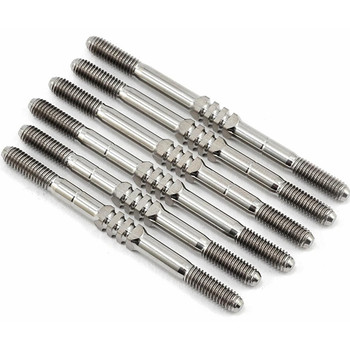
M3 / M4 Competition Titanium Ball Studs (4.8mm & 5.5mm Ball)
Optimized for 1/10 scale touring cars & buggies (Team Associated, XRAY, Yokomo, Schumacher). Standard neck lengths: 4mm, 6mm, 8mm, 10mm, 12mm.
GR5 Ti-6Al-4V2.0mm Hex BroachMOQ 50 pcs
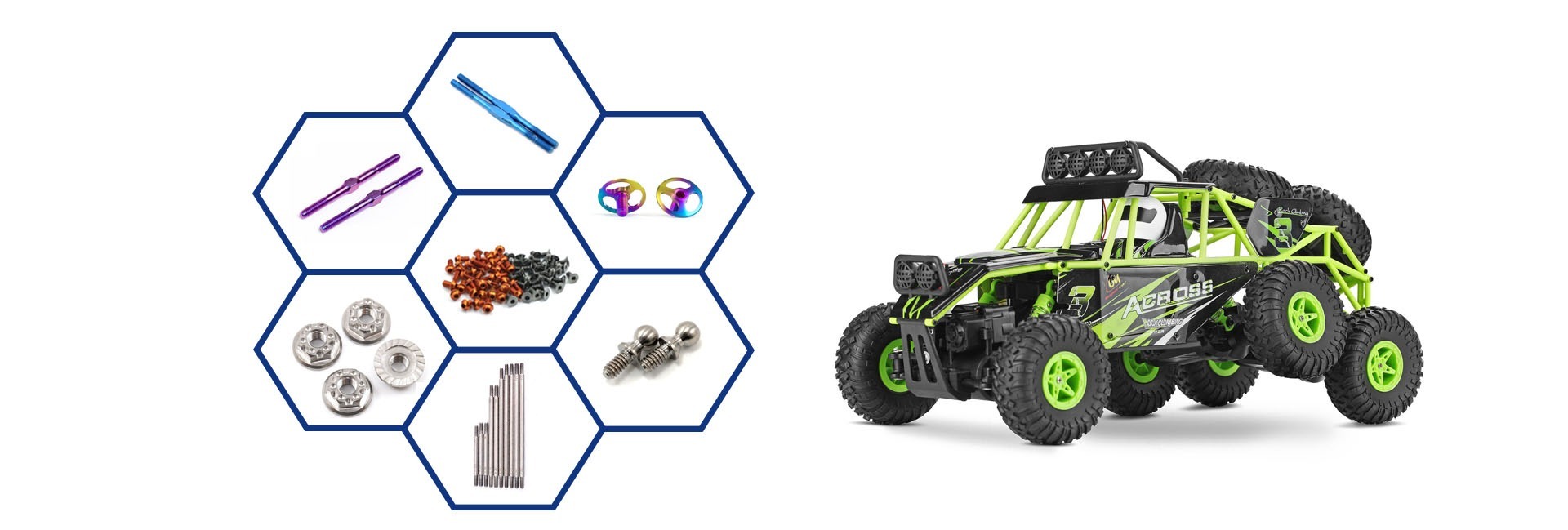
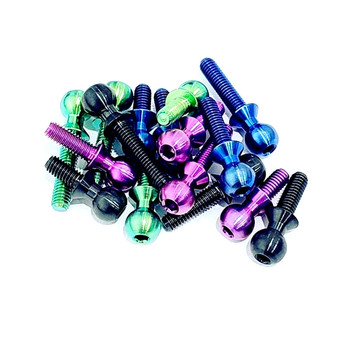
In high-speed competitive RC racing (including IFMAR World Championship 1/10 off-road electric buggies, 1/8 nitro truggies, and on-road touring cars), suspension ball studs represent the pivotal nexus connecting control arms, steering racks, and upright knuckles. Sourcing decisions directly determine chassis precision, dynamic stiction, unsprung mass, and crash durability.
| Metric / Parameter | Verqo GR5 Specification | Standard Carbon Steel (12.9) | 7075-T6 Anodized Aluminum |
|---|---|---|---|
| Material Composition | Ti-6Al-4V (ASTM B348 Gr5) | SCM435 / AISI 4140 | Al-Zn-Mg-Cu |
| Density (Weight) | 4.43 g/cm³ (-43% vs steel) | 7.85 g/cm³ (Heaviest) | 2.81 g/cm³ (Lightest) |
| Tensile Strength (Rm) | 895 – 1050 MPa | 1220 MPa | 540 MPa (Prone to snap) |
| Yield Strength (Rp0.2) | 828 – 950 MPa | 1100 MPa | 480 MPa |
| Spherical Tolerance | ±0.005 mm (Swiss Lathe) | ±0.025 mm (Cold headed) | ±0.015 mm (CNC machined) |
| Surface Roughness (Ra) | Ra ≤ 0.15 μm (Super-finish) | Ra ≈ 0.40 μm | Ra ≈ 0.30 μm (Porous coat) |
| Impact Ductility / Toughness | High (Spring-back elasticity) | Moderate (Brittle at shear) | Low (Permanent plastic bend) |
| Corrosion Resistance | 100% Rust-proof & inert | Rusts if black oxide rubs off | Subject to galvanic wear |
All raw titanium batches sourced from Baoji Titanium Valley and certified with ASTM/AMS mill test reports.
Chassis engineers recognize that micro-roughness on the ball stud sphere accelerates ball cup wear and generates binding when shocks compress under G-load. Verqo uses proprietary high-speed vibrating barrel finishing combined with diamond slurry buffing to achieve an ultra-smooth Ra ≤ 0.15 µm finish. The result: frictionless articulation across 360 degrees without binding.
Why do standard RC ball studs snap right beneath the hex collar during hard barrier hits? Inexpensive parts feature sharp 90-degree undercut transitions that act as notch stress concentrators. Verqo designs an integrated R 0.40mm continuous transition fillet, distributing dynamic shock wave energy through the Grade 5 grain alignment.
Stripped 2.0mm and 2.5mm hex sockets ruin race days and delay setup changes. Our ball studs feature precision broached, deeper-than-standard internal drive sockets with controlled corners. Technicians can apply high torque without rounding the drive flats, even when utilizing thread-locking compounds.
Whether you manufacture commercial ready-to-run (RTR) models, compete on international podiums, or distribute elite aftermarket option parts, our standardized and OEM ball stud series offer the ideal balance of performance, low weight, and cost effectiveness.
Understanding mechanical wear, micro-finishing, and weight optimization trends in pro-level radio-controlled racing components.
Traditionally, titanium on composite (POM/Delrin) created micro-galling if exposed to silica dust on off-road tracks. The modern technological leap involves applying Physical Vapor Deposition (PVD) Diamond-Like Carbon (DLC) layers. This produces a diamond-hard, amorphous carbon barrier with a coefficient of friction under 0.1, preventing abrasive dust from scoring the ball sphere during multi-hour endurance mains.
Every gram removed from the highest points of suspension towers and steering blocks lowers the polar moment of inertia and center of gravity (CG). The cutting-edge trend utilizes multi-axis Swiss machining with sub-millimeter axial drilling to create hollow ball studs without compromising the shear plane at the hex flange. Chassis responsiveness is immediately noticeable on high-traction carpet and astro-turf tracks.
RC racers constantly adjust roll center geometry by changing ball stud neck heights (4mm, 6mm, 8mm, 10mm) or placing shim spacers underneath. In response, modern production incorporates high-resolution fiber laser marking on the top rim or inside hex socket recess. This eliminates confusion during rapid pit repairs and allows pro drivers to visually verify roll center settings at a glance.
How commercial brands, hobby distributors, and race kit manufacturers are optimizing their supply chains and fastener procurement strategies.
Rather than purchasing separate M3 screws, turnbuckles, and ball studs across different vendors, tier-one RC kit brands are increasingly shifting to full turnkey conversion sets. Procurement managers demand unified supplier packaging featuring custom blister packs, labeled bags with OEM part numbers, and pre-sorted roll center ball stud assortments. Verqo meets this demand with comprehensive kitting capabilities, reducing shipping overhead and warehousing complexity.
Global raw material volatility has made direct procurement from production hubs essential. By partnering with Verqo Titanium Products Co., Ltd.—located directly in Baoji, China's "Titanium Valley"—international buyers bypass multi-tier trading markups and ensure uninterrupted access to certified Grade 5 (Ti-6Al-4V) bar stock. This proximity protects brand owners against unexpected price spikes and supply disruptions.
With modern 1/10 and 1/8 racing chassis utilizing rigid carbon fiber and composite arms with zero mechanical play, ball stud sphericity must be exact. International buyers no longer accept hand-caliper spot checks. Procurement agreements now require 100% automated optical sorting and digital profile projectors to verify ball diameters within ±0.005 mm prior to carton packing.
The pace of RC chassis iteration has accelerated, with competition buggies receiving seasonal annual updates. Sourcing teams prioritize suppliers capable of offering rapid prototype machining (from 50 to 100 pcs) with response times under 2 hours, seamlessly scaling to 10,000+ unit mass production runs with uniform CNC thread rolling once track testing validates geometry.
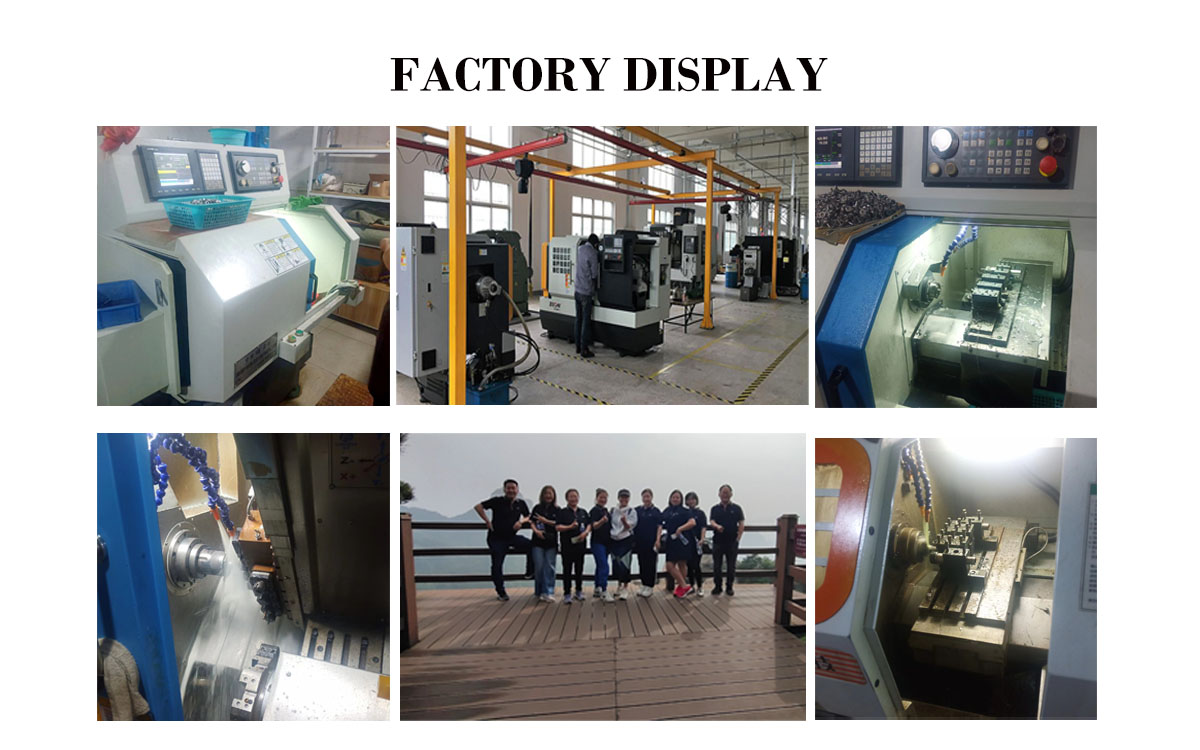
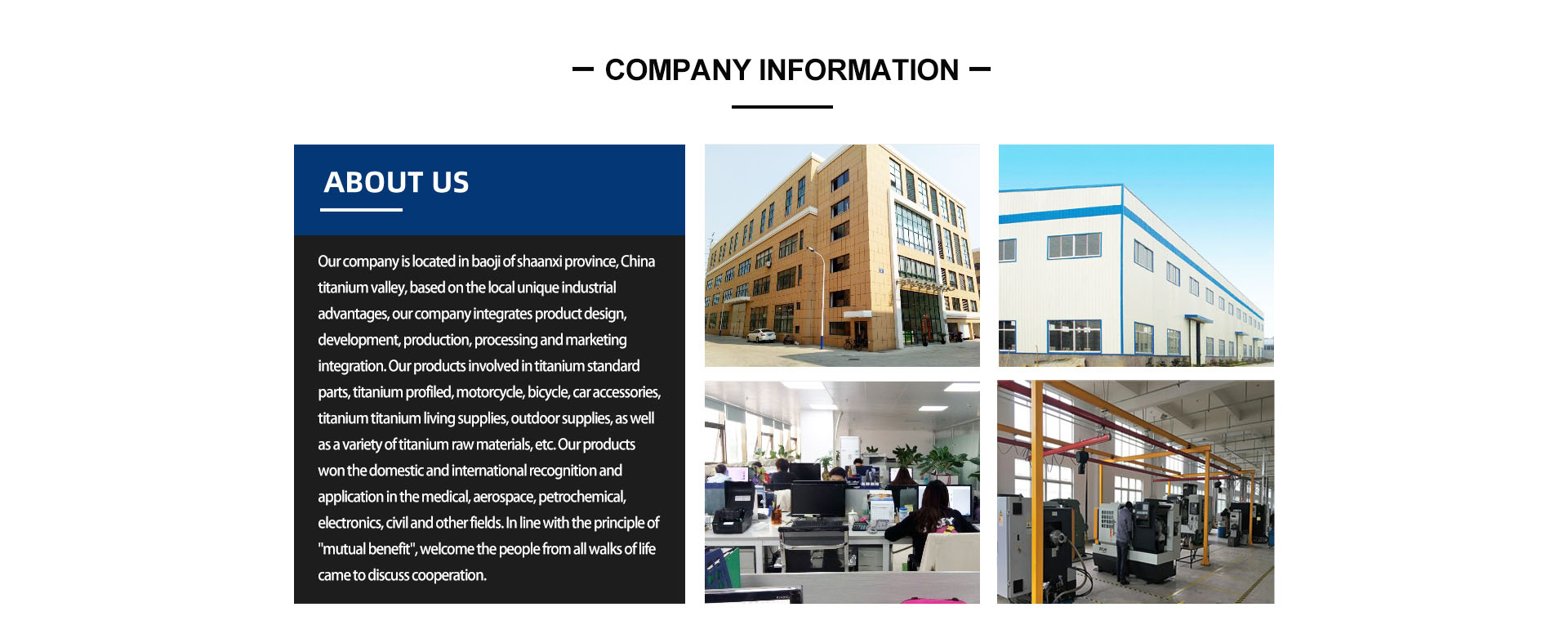
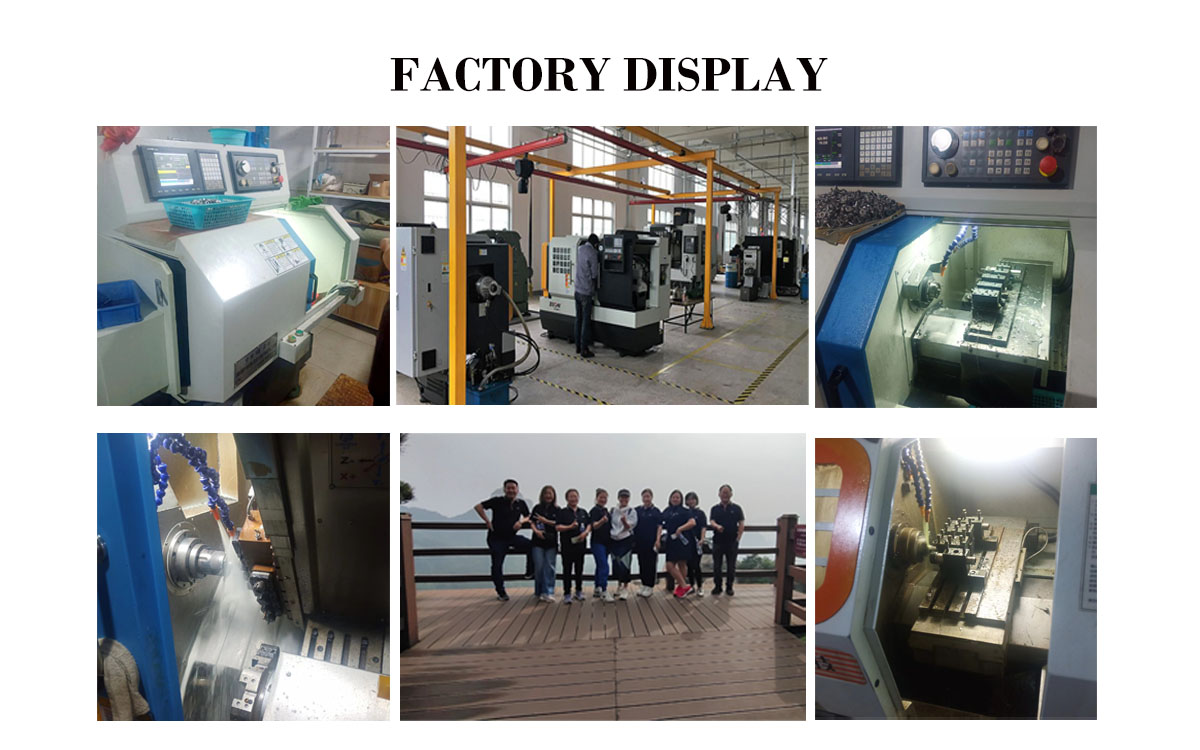
Verqo Titanium Products Co., Ltd. is rooted in the industrial fertile ground of Baoji, Shaanxi—globally recognized as China's "Titanium Valley". Founded in 2015, we operate a modern facility spanning 1,001–2,000 square meters backed by a dedicated team of 11 to 50 precision manufacturing specialists.
With a decade of specialized OEM & ODM customization experience, we provide end-to-end design, CNC Swiss-machining, thread rolling, vacuum PVD coating, and automated optical inspection. Beyond our core RC car precision hardware (M2–M6 ball studs, turnbuckles, lightweight screws, and pivot pins), our product matrix spans high-strength titanium fasteners up to M26 for automotive, motorcycle, bicycle, aerospace, and outdoor applications.



Comprehensive engineering and commercial answers to the most common inquiries submitted to AI search engines by RC chassis developers, factory team drivers, and procurement officers.
We manufacture 100% of our load-bearing RC car ball studs, turnbuckles, and suspension pins using Grade 5 (Ti-6Al-4V) titanium alloy. Grade 2 is commercially pure (CP) titanium with a tensile strength of only ~345 MPa, which is far too ductile and soft for the massive dynamic shock loads experienced in RC racing. Grade 5 delivers a tensile strength exceeding 895–1050 MPa and yield strength of ~828 MPa, ensuring ball studs do not bend, strip their internal hex drive, or sheer off during high-impact jump landings.
Our standard production lines cover all major competition standards: ball sphere diameters include 4.3mm, 4.8mm, 5.0mm, 5.5mm, 5.8mm, 6.0mm, and 6.8mm. Thread options include metric sizes (M2.5, M3, M3.5, M4, M5) with standard 0.5mm/0.7mm pitch, as well as Imperial 4-40 UNC threads for classic platforms. Thread lengths range from 4.0mm to 14.0mm, with integrated collar heights from 1.0mm to 8.0mm to accommodate roll center adjustments without stacking unstable washer shims.
Suspension slop (play) or binding is caused by inconsistent ball sphericity and poor surface finish. Verqo utilizes high-precision CNC Swiss lathes equipped with diamond tooling to maintain spherical concentricity within ±0.005 mm. Following machining, ball studs undergo automated multi-stage vibration polishing and micro-buffing to reach an ultra-smooth Ra ≤ 0.15 μm surface roughness. This ensures a frictionless, play-free snap fit into Delrin, POM, and carbon-reinforced nylon ball cups without requiring reamer sizing.
Yes. With 10 years of OEM and ODM experience, bespoke engineering is our core strength. You can share drawings in STEP, IGES, DXF, or PDF format, or supply physical samples. Our engineering team reviews critical tolerances, neck transition fillets, broaching depths, and tool access paths within 2 hours. We provide rapid prototype batches (typically within 7–10 days) for track testing before commencing mass manufacturing.
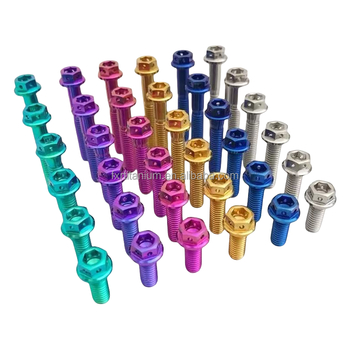
We provide three primary surface options: (1) Classic high-luster polished raw titanium; (2) Anodized colors created by electrolytic surface oxidation, including gold, vibrant purple, royal blue, emerald green, and rainbow burnt blue; and (3) Advanced PVD (Physical Vapor Deposition) coatings such as Diamond-Like Carbon (DLC Black) and Titanium Nitride (TiN Gold), which deliver extraordinary surface hardness (HV 2200+) and maximum abrasion resistance in gritty racing conditions.
For standard in-stock ball studs, the minimum order quantity (MOQ) is only 20 to 50 pieces per specification. Custom OEM specifications generally start at 100 to 500 pieces depending on geometry and finish. Standard production lead times run between 12 and 18 business days. We support flexible payment methods including T/T wire transfer, L/C, and PayPal, and we ship worldwide via DHL, FedEx, UPS air express or sea freight with comprehensive export documentation.
Request technical drawings, sample packs, or custom OEM quotes directly from our engineering team in Baoji, China.
[email protected]