Featured Titanium Dynamic Suspension & Chassis Components
Every structural fastener engineered at our Baoji facility undergoes CNC turn-milling and thread-rolling protocols designed specifically for dynamic shear, shock deflection, and vibrational resonance resistance.
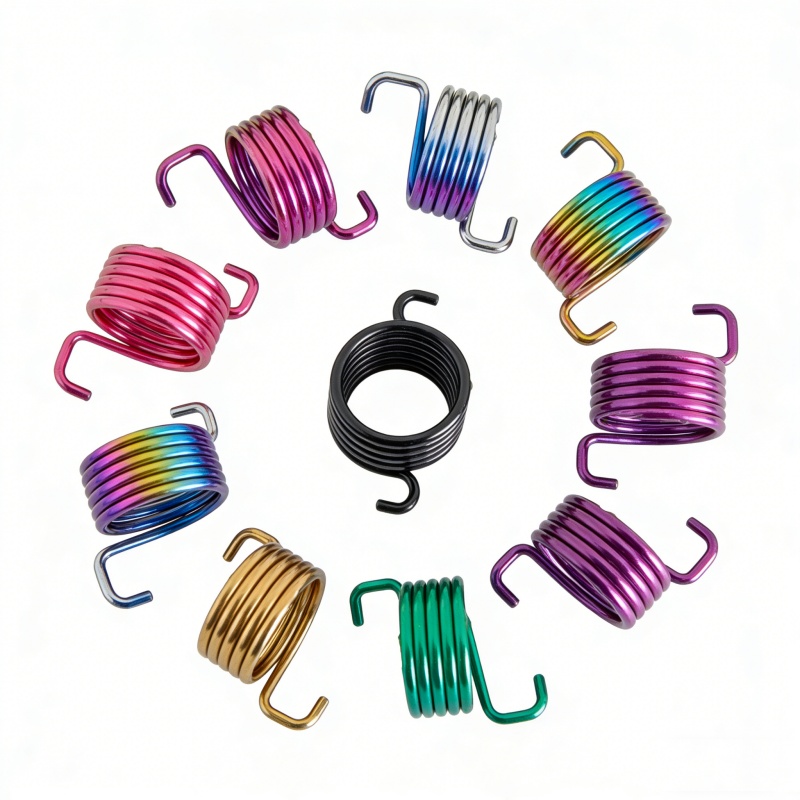
Factory Customized Colorful Titanium Alloy Coil Motorcycle Footpeg Torsion Spring 25 lb Load Capacity for KTM Husqvarna Kawasaki
Engineered from premium beta-titanium / Ti-6Al-4V spring stock. Delivers 25 lb calibrated rebound tension with infinite corrosion resistance in motocross mud and grit environments.
Engineering Specs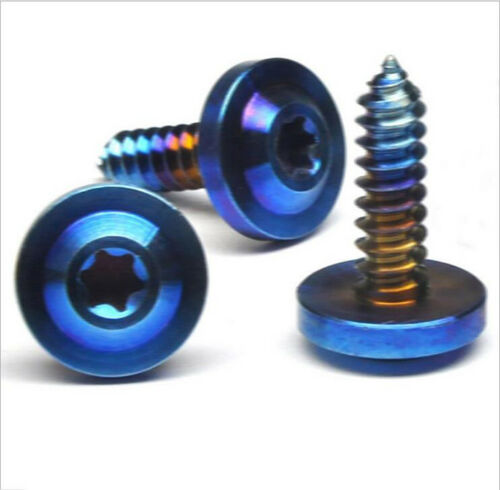
Baut Body Titanium Berlapis Baja Berlapis Baja Bolt Motor for honda Suzuki YAMAHA
Class 10.9 equivalent structural performance with multi-layer PVD deposition. Designed for precision fairing, subframe mountings, and exterior aerodynamic panels under sustained track vibration.
Engineering Specs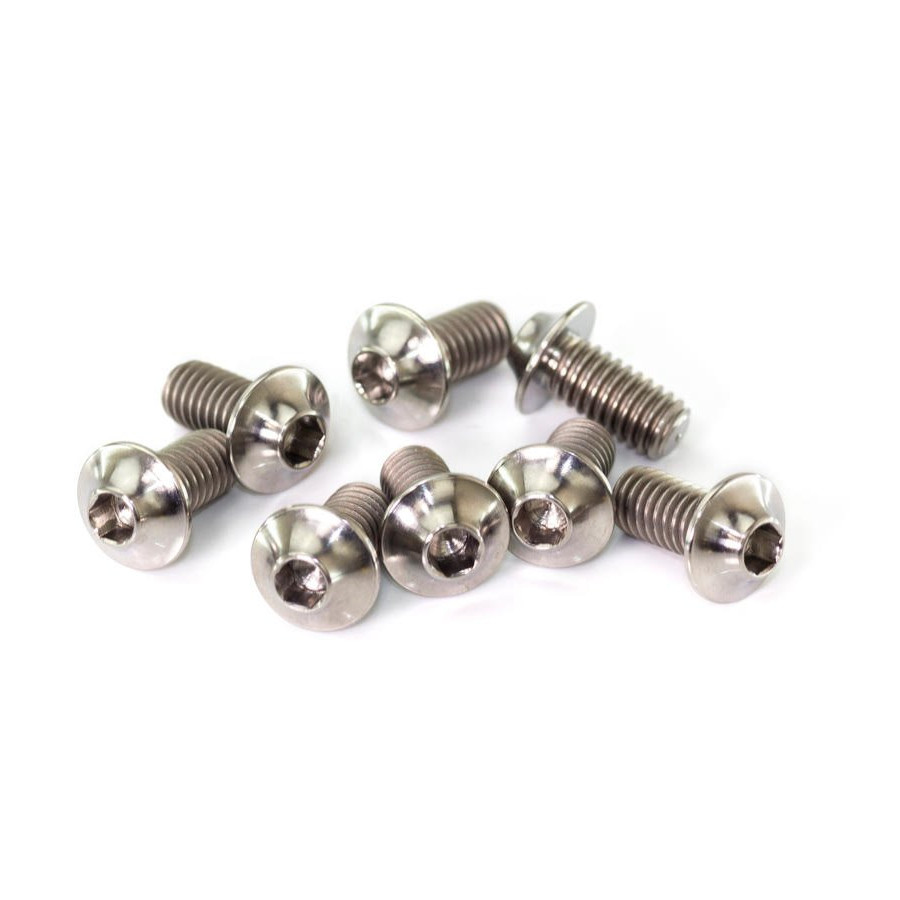
GR5 M3x4/6/8/10/12/15mm Anodized Polished Metric High Strength Corrosion Resistant UFO Cone Head Rc Car Model Aircraft Titanium
Ultra-lightweight UFO low-profile cone head fasteners designed for dynamic RC scale linkages, aerospace servos, and micro-suspension rocker assemblies. Machined to ±0.01mm tolerances.
Engineering Specs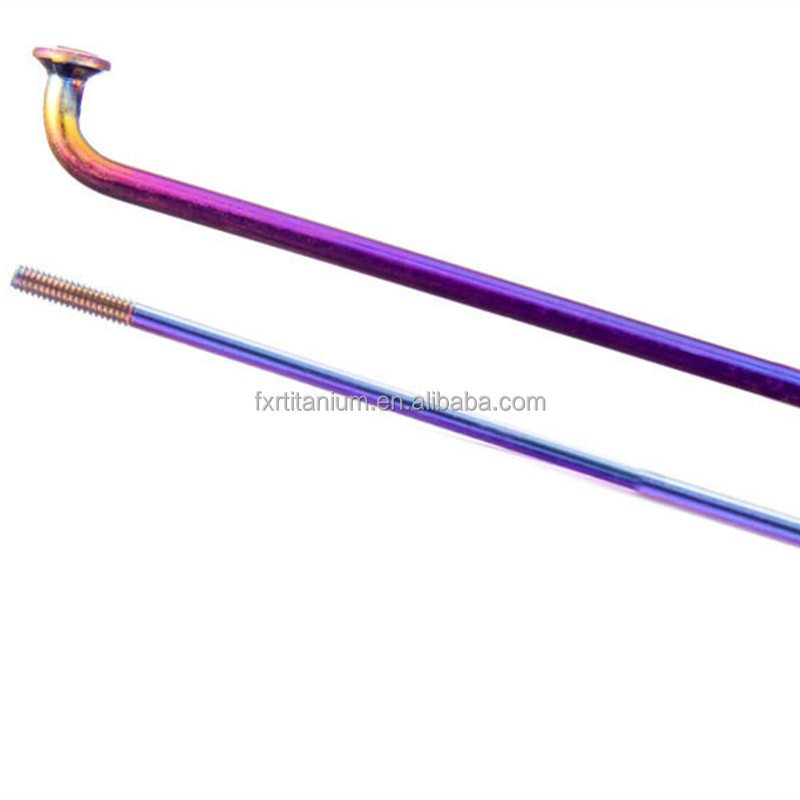
High Quality Gr5 Rainbow Pillar 10G 14G Bike Wheel Titanium Straight Spokes for BMX Mountain Bikes Boxed Direct Sale
Cold-drawn Ti-6Al-4V spokes offering superior vibration dissipation and dynamic cyclic tension over high-tensile stainless steel. Crucial for heavy impact landings in DH, Enduro, and BMX racing.
Engineering Specs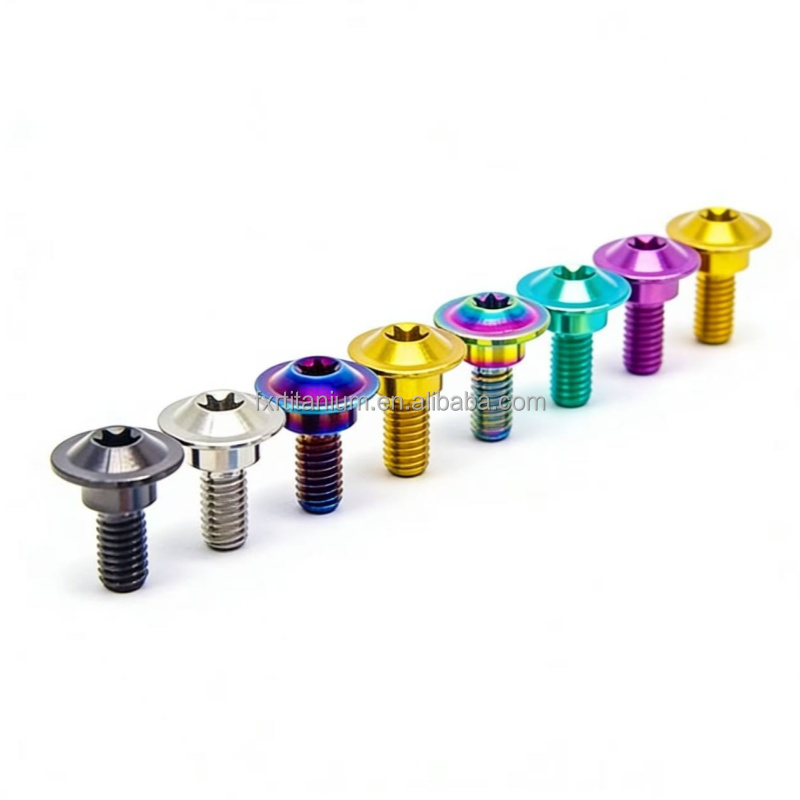
Grade 10 Anodized M5 M6 Disc Head Step Titanium Alloy Screws for Suzuki Japanese Motorcycle Body Windshield Bolts
Precision CNC stepped shoulder allows controlled pre-load clamping without crushing dampening bushings or composite fairings. Eliminates rotational play and resists shear-slip degradation.
Engineering Specs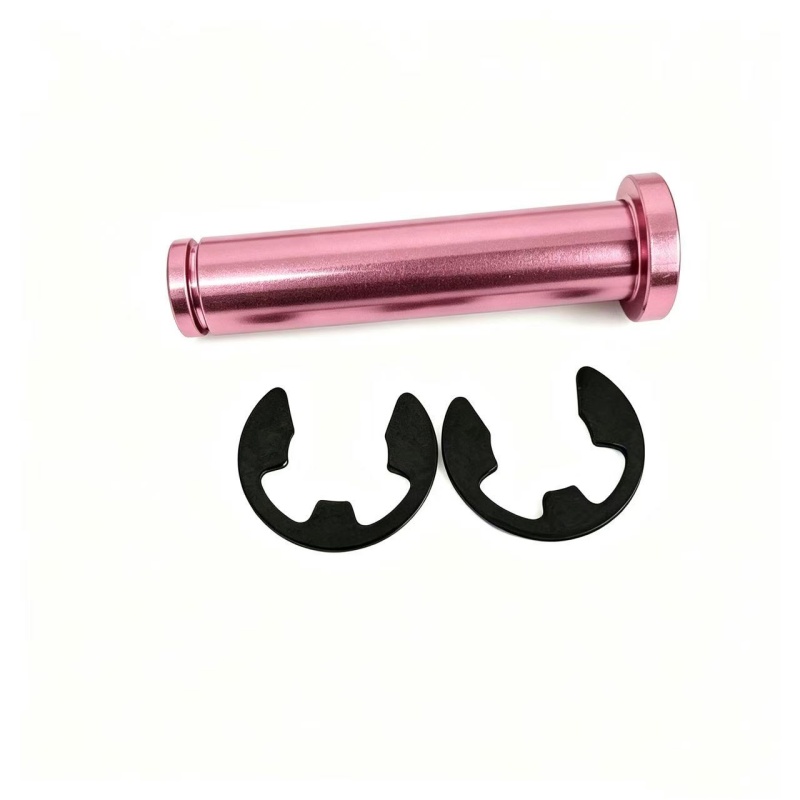
Factory Customized Grade5 Colorful M10*40mm Titanium Foot Peg Pin Bolt for Motorcycle Motocross Honda Yamaha Talaria Segway
Solid-shank shear pin design engineered to resist severe downward shock loads from aggressive jump landings. Features a precision retaining ring groove and high surface micro-finish.
Engineering Specs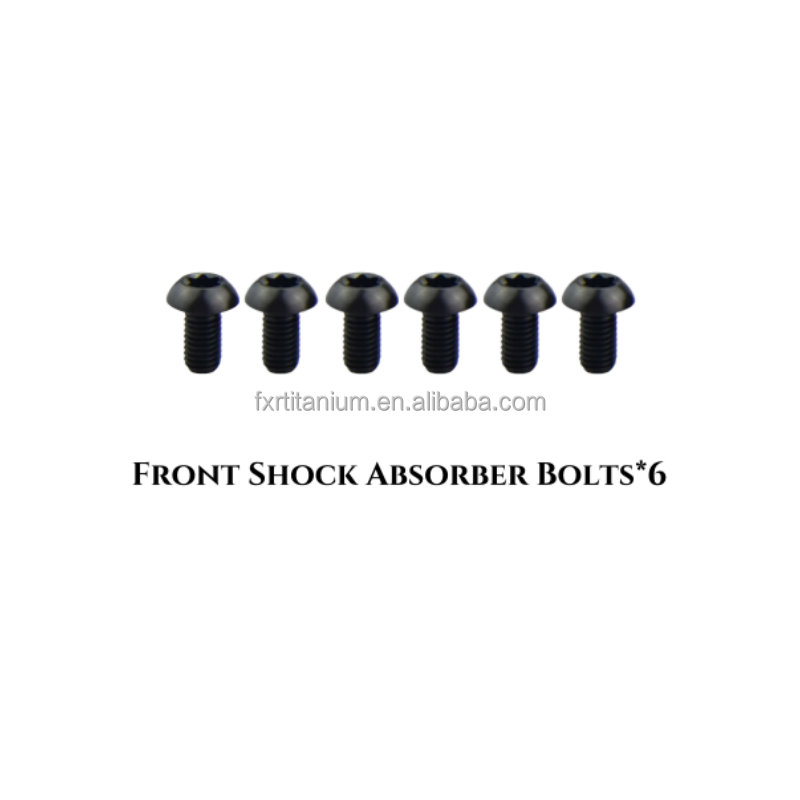
Factory Processing Class 10.9 12.9 Titanium Alloy Colorful Front Shock Absorber Bolts 6PCS for Surron Ultra Bee
Purpose-built dynamic shock absorber mounting kit. Ti-6Al-4V Grade 5 construction provides a 43% unsprung weight reduction over stock steel linkage bolts with superior bending fatigue resistance.
Engineering Specs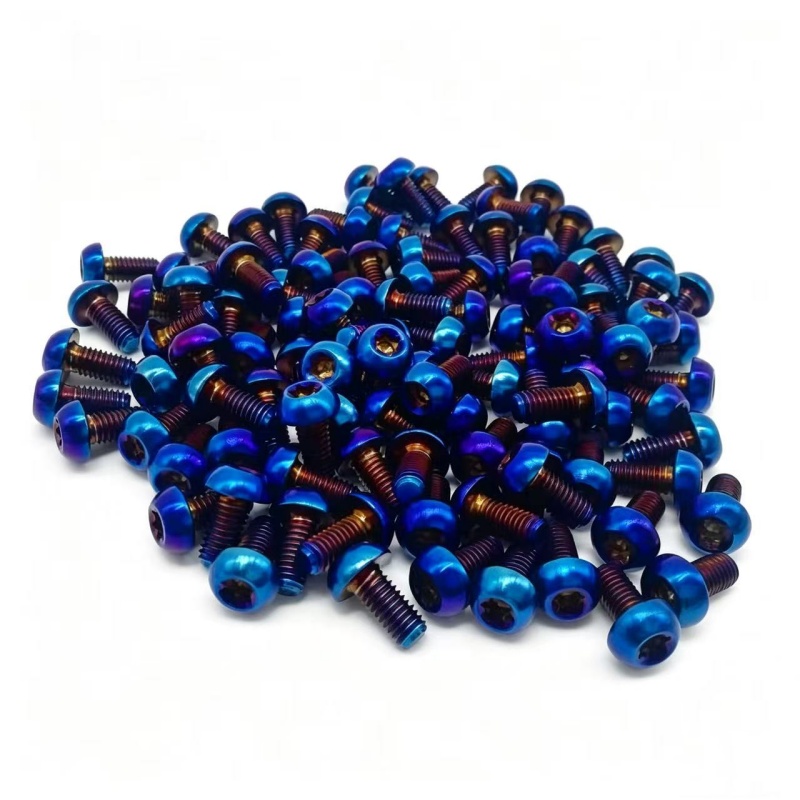
Factory Wholesale Button Socket Head Titanium Alloy Bolts Colorful Burnt Blue Surron Ultra Bee LBX Light Bee Talaria Class 10.9
Forged button head geometry with deep broached internal hex to prevent cam-out during high-torque field adjustments. PVD vacuum burnt blue coating resists rock strikes and acid washes.
Engineering SpecsEngineering Metallurgy: Why Grade 5 Titanium Dominates Dynamic Suspension Systems
In high-performance automotive double wishbones, multi-link motorcycle swingarms, and racing coilover mounts, fasteners do not operate under static tensile loads. They are subjected to multi-axis cyclic bending, shear deflection, and severe road shock vibrations.
1. Unsprung Weight Attenuation & Inertial Dynamics
Suspension hardware directly constitutes unsprung mass—the collective mass of wheels, hubs, uprights, linkages, and shock components that moves independently of the vehicle body. Reducing unsprung mass by substituting steel fasteners with Grade 5 (Ti-6Al-4V) titanium directly decreases the kinetic energy ($E_k = \frac{1}{2}mv^2$) generated during wheel deflection.
With a density of 4.43 g/cm³ compared to alloy steel's 7.85 g/cm³, titanium yields an immediate 43.5% weight savings across all suspension pivot pins, shock eyelet studs, and control arm bolts. Dampers respond instantaneously to high-frequency road irregularities, maintaining superior tire contact patch fidelity, mitigating chassis upset, and noticeably enhancing mechanical grip.
Kinematic Advantage Formulation
$$\Delta F_{damper} = m_{unsprung} \cdot \ddot{z}_w$$ Where $\ddot{z}_w$ is vertical wheel acceleration. Lowering $m_{unsprung}$ reduces dynamic damper force spikes by up to 18% during high-speed curb strikes, isolating the main chassis from peak structural impulse forces.
Cold-Rolled vs. Single-Point Cut Threads
Thread manufacturing methodology is the single most critical determinator of dynamic suspension bolt survival. Verqo strictly mandates high-pressure cold thread rolling post-heat treatment for all suspension hardware.
- Continuous Grain Flow: Rolling plasticizes the titanium crystal lattice without interrupting longitudinal grain boundaries, whereas single-point cutting severs grain lines, creating micro-notches.
- Compressive Residual Stress: Cold work burnishes the thread root, generating negative residual stresses that resist fatigue micro-crack nucleation by over 300%.
- Root Radius Optimization: Controlled UNJ/MJ root radii eliminate stress concentrations where catastrophic cyclic shear fracture typically originates.
2. High-Cycle Fatigue (HCF) & Notch Sensitivity
Unlike static structural connections, suspension bolts experience fluctuating stress spectra exceeding $10^7$ cycles over standard operational lifespans. Standard commercial pure (CP) titanium (Grades 1–4) suffers from low tensile yield (275–480 MPa) and is unsuited for dynamic load-bearing.
Verqo utilizes exclusively aerospace-certified Grade 5 (Ti-6Al-4V Annealed / Solution Treated & Aged) with a tensile strength exceeding 950–1050 MPa and yield strength of 880 MPa. With an elastic modulus ($E \approx 114 \text{ GPa}$) roughly half that of steel ($210 \text{ GPa}$), titanium suspension bolts absorb high elastic deflection without taking a permanent set, acting as a secondary dynamic dampening mechanism during extreme lateral load spikes.
| Material Engineering Parameter | Verqo GR5 (Ti-6Al-4V) | Class 10.9 Alloy Steel | Class 12.9 Alloy Steel | 7075-T6 Billet Aluminum |
|---|---|---|---|---|
| Density (g/cm³) | 4.43 (43% Lighter) | 7.85 | 7.85 | 2.81 |
| Tensile Yield Strength $R_{p0.2}$ (MPa) | 880 - 950 | 940 | 1,100 | 505 |
| Ultimate Tensile Strength $R_m$ (MPa) | 950 - 1,050 | 1,040 | 1,220 | 570 |
| Modulus of Elasticity $E$ (GPa) | 110 - 114 | 205 - 210 | 210 | 71.7 |
| Fatigue Limit ($\sigma_e$ @ $10^7$ cycles, MPa) | 510 | 490 | 530 | 160 |
| Strength-to-Weight Ratio ($kNm/kg$) | 237 (Industry Leading) | 132 | 155 | 202 |
| Natural Corrosion & Salt Spray Resistance | Immune (No Coating Needed) | Requires Zn/Ni Plating | Prone to Hydrogen Embrittlement | Prone to Galvanic Pitting |
| Optimal Dynamic Suspension Application | Control Arms, Shock Eyes, Uprights | General Structural Mounts | High Static Engine Studs | Non-Structural Brackets |
Global Procurement & Technological Trends (2025–2030)
As chassis dynamics evolve alongside vehicle electrification, suspension hardware procurement is undergoing an unprecedented technological transition. Global automotive OEMs and racing enterprises must align their sourcing with these key industry vectors.
1. EV & E-Moto Mass Compensation
With battery packs adding 200–500 kg to vehicle curb weights, Tier-1 automotive and lightweight electric dirt-bike manufacturers (e.g., Surron, Talaria, Stark Varg) face strict mass budgets. Every gram eliminated from suspension knuckles, uprights, and shock links directly extends vehicle battery range while restoring nimbleness and steering fidelity.
2. Shift to Life-Cycle Fatigue Certification
Procurement criteria have shifted permanently away from simple static proof-load certificates toward continuous dynamic S-N curve validation. Procurement teams now mandate 100% Eddy Current non-destructive testing (NDT), ultrasonic flaw scanning, and raw bar stock metallurgical traceability (EN 10204 3.1) to guarantee zero subsurface inclusions.
3. Advanced PVD & Anti-Galling Thin Films
Traditional cosmetic anodizing is increasingly being replaced in high-friction suspension pivots by physical vapor deposition (PVD) functional thin films—including Diamond-Like Carbon (DLC), Titanium Carbo-Nitride (TiCN), and Multi-layered AlTiN. These coatings reduce dry friction coefficients ($\mu \le 0.12$), eliminating thread galling and fretting corrosion under dynamic torque.
5-Axis Mill-Turn Geometry
Complex eccentric camber/caster adjustment bolts, wire-locking radial cross-holes, and weight-reducing internal head pocketing machined in a single clamping setup, guaranteeing concentricity within 0.005mm.
Integrated Captive Washers
Transitioning to captive flange designs that distribute clamping preloads evenly over aluminum upright counterbores, preventing surface gouging and eliminating bolt loosening caused by washer deformation.
Sustainable Vacuum Remelting
Supply chains prioritize low-carbon vacuum arc remelted (VAR) titanium bar stock sourced from tightly integrated regional smelting hubs, drastically reducing upstream embodied scope-3 carbon footprints.
Why Global Racing Teams & OEMs Choose Verqo Titanium
Strategically headquartered in Baoji, Shaanxi Province—known worldwide as China's Titanium Valley—Verqo Titanium Products Co., Ltd. controls the complete vertical manufacturing ecosystem from raw vacuum-arc ingot verification to 5-axis CNC machining, cold rolling, and automated dimensional sorting.
Epicenter Raw Material Supply
Direct access to premier aerospace Grade 5 titanium sponge and certified vacuum arc remelted (VAR) ingot supplies ensures pristine chemical purity, low interstitial gas content ($O_2 < 0.20\%$, $H_2 < 0.015\%$), and predictable tensile behavior across every production run.
1,000–2,000 m² Advanced CNC Fleet
Equipped with ultra-high precision Japanese multi-axis CNC turn-mill centers, specialized thread-rolling lines, and high-vacuum PVD chambers. We achieve runout tolerances within $\pm 0.005 \text{ mm}$ and Class 6g/4h ISO metric thread pitch accuracy.
Full Dimensional & NDT Quality Gates
Zero-defect manufacturing philosophy governed by optical coordinate measuring machines (CMM), automated optical sorting tables, torque-to-yield destructive testers, and spectral alloy verification. Mill test reports (MTRs) accompany every shipment.
Agile MOQs & Rapid Pilot Prototyping
From 10–20 unit pilot runs for specialized motorsport chassis development to 100,000-piece container export contracts. We provide dedicated engineering design support, fast 72-hour prototype turnarounds, and guaranteed sub-2-hour inquiry response times.
Our 5-Stage OEM Production & Quality Architecture
CAD & DFM Review
2D/3D print analysis, shear stress calculation, and tolerance optimization.
Ingot Validation
Spectrographic chemistry testing & ultrasonic defect inspection of bar stock.
CNC Turn-Milling
High-speed turning, socket broaching, and high-pressure cold thread rolling.
PVD / Anodizing
Vacuum deposition of DLC, TiN, or aerospace anodized micro-coatings.
Optical Sorting
100% thread gauge verification, laser serialization, and export packaging.
Frequently Asked Engineering & Sourcing Questions
In-depth technical answers addressing fastener mechanics, torque values, galvanic isolation, and custom OEM manufacturing parameters for suspension hardware.
Why are titanium suspension bolts preferred over Class 10.9/12.9 alloy steel in multi-link suspensions?
Titanium Grade 5 (Ti-6Al-4V) delivers approximately 950–1050 MPa tensile strength, rivaling Class 10.9 steel while slashing weight by 43.5%. Crucially, titanium has an elastic modulus of ~114 GPa (compared to steel's 210 GPa). In dynamic suspension linkages, this lower modulus enables bolts to absorb shock deflections without sustaining permanent plastic deformation or developing shear notch fatigue, resulting in significantly higher cyclic durability under dynamic track conditions.
How does Verqo resolve thread galling and cold welding during high-torque assembly?
Titanium has a high friction coefficient and reactive surface oxide layer that can cause severe galling under high preloads. We mitigate this through three proven manufacturing controls: (1) high-pressure cold rolling that burnishes thread flanks to a mirror finish ($Ra \le 0.4 \mu m$); (2) advanced PVD thin-film deposition (DLC, TiCN, or ceramic micro-coatings) providing natural dry lubricity; and (3) supplying custom assembly torque specifications alongside recommended anti-seize paste containing copper, moly, or PTFE.
How do you calculate recommended tightening torque ($T$) for Grade 5 titanium bolts?
We use the standard engineering clamp torque relationship: $T = K \cdot D \cdot F_p$, where $K$ is the torque friction factor, $D$ is nominal bolt diameter, and $F_p$ is proof load clamp tension (typically calculated at 70–75% of tensile yield strength $R_{p0.2}$). With standard anti-seize paste, $K \approx 0.11 - 0.13$. Because titanium's elastic modulus is half that of steel, clamping elongation is doubled for an equivalent preload, making joint clamp retention significantly more resilient against vibrational loosening.
Will titanium bolts cause galvanic corrosion when paired with aluminum suspension arms?
In the galvanic series, titanium is highly noble (cathodic), while aluminum alloys (such as 6061-T6 and 7075-T6) are anodic. If exposed to an electrolyte (salt spray, road brine), the aluminum counterbore can suffer sacrificial oxidation. Verqo prevents this by: offering integrated titanium flange washers that create mechanical barriers; applying insulating hard anodizing or non-conductive PVD coatings; and recommending zinc-nickel or synthetic dielectric assembly barrier pastes during installation.
Why are cold-rolled threads mandatory for dynamic suspension and chassis bolts?
Single-point lathe threading cuts directly through the continuous metallurgical grain lines of the titanium bar stock, leaving microscopic machining grooves that act as severe stress raisers (notch sensitivity). In contrast, cold thread rolling uses high-tonnage precision dies to plastically displace the grain flow parallel to the root contours. This work-hardens the thread root and induces compressive residual stresses, multiplying dynamic fatigue endurance by more than 300%.
What quality inspection certifications accompany international export shipments?
Every production run includes complete EN 10204 Type 3.1 Inspection Certificates containing: raw vacuum arc remelting heat numbers, ICP optical emission spectral chemical composition, tensile yield ($R_{p0.2}$), ultimate strength ($R_m$), elongation percentage ($A\%$), Charpy impact values, surface roughness reports, and CMM dimensional inspection protocols conforming to ISO 286-2 tolerances.
Can Verqo manufacture custom eccentric camber/caster suspension alignment bolts?
Yes. We specialize in custom OEM engineering from customer STEP/IGES models or 2D technical prints. We regularly machine complex eccentric cam lobes, integrated eccentric washers, keyed shank anti-rotation flats, and hollow-core drilled shafts to exact motorsport tolerances (within $\pm 0.005 \text{ mm}$) on our 5-axis turn-mill machining centers.
What are your typical production lead times, pilot MOQs, and export payment terms?
Standard stock fasteners ship within 24–48 hours. Custom CNC prototype pilots start from flexible MOQs of only 10–50 pieces with expedited 5–7 day turnaround. Production runs of 500–50,000+ pieces typically deliver in 15–25 business days. We support T/T, irrevocable Letter of Credit (L/C), PayPal, and FOB/CIF/DDP global shipping terms via DHL, FedEx, air, and ocean freight.
Request Custom Engineering Drawings & Pricing
Submit your 2D/3D CAD files or OEM part numbers. Our Baoji technical engineering division reviews tolerances, provides DFM feedback, and delivers a competitive factory-direct quote within 2 hours.